The fabric used for the Tiger fatigues procured in Japan was cotton twill, which was commonly used for work clothes and other items on the market at the time. Typical examples are Katsuragi(left-hand twill) and West Point (right-hand twill). Incidentally, a thin plain-weave cotton fabric called poplin was widely used for Tiger fatigues used by the South Vietnam Marines, but it appears to have been rarely used for Tiger jackets procured in Japan for the US military and CIDG (Note1).
This is thought to be because, when procuring fabric, certain conditions were attached to the ounce weight, which is directly related to the strength of the fabric used.
The cotton fabric used for these Tiger jackets in Japan at the time was produced in Hamamatsu, Okayama, Hiroshima, and Senshu (southern Osaka Prefecture). The looms used were, of course, power looms (shuttle looms), and the fabric width was around 38 inches (97 cm), all with selvedge. These cotton fabrics were the most common on the market in the 1960s, but now, with the development of weaving machines and the rise of synthetic fibers, they have mostly disappeared from the market. If you want something with the exact same specifications as back then, the only option left is to contract with a factory that owns power looms, the number of which is decreasing every year, and have it custom-made.
Note1)
CIDG (Civilian Irregular Defense Group program):
This militia unit, which appears in the movie "Apocalypse Now," was formed based on the United States' irregular warfare strategy during the Vietnam War. Members were recruited from the Montagnards, an ethnic minority group living in the mountainous region of central Vietnam.
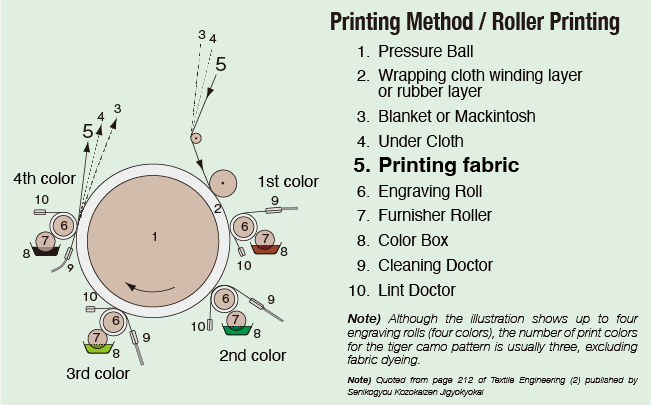
Next, there is the printing method of tiger camo. Vietnam Tiger camo has a wide variety of variations and has created many tiger enthusiasts and collectors around the world in Later generations. Most were printed using a method called roller printing (machine printing) with the exception of some souvenir tigers.
The reason for this is that the roller method was the most common fabric printing method in the 1960s, and also because of the cost benefits that came from its overwhelmingly faster printing speed compared to other methods.
It's precisely the characteristics of the roller printing method that have given rise to the many tiger print variations. Roller printing is the oldest of all machine-based printing methods for fabric, hence the name "Machine Printing", or simply "Machine". The method involves running the fabric against a large cylinder, around which a roller (4-8 inches in diameter) with a pattern engraved on its surface rotates. The ink collects in the depressions of the roller, which then transfers to the continuously moving fabric, forming the print. One roller is required for each color, and as many rollers as there are colors. The diameter of the roller plays a major role in tiger variations. Since the pattern engraved on the cylinder's surface is printed endlessly as it rotates, the roller's diameter multiplied by pi determines the pattern pitch (feed width). Using different diameters roller makes it impossible to print the same pattern. Typically, print factories use rollers of a convenient width and diameter, rarely using different types of rollers. Therefore, in order to print at a different printing factory, the pattern had to be adjusted to fit the rollers used at that factory. It was sometimes necessary to select the fabric to be used based on the width of the rollers used.
Furthermore, the colorants used at each factory were naturally different, and of the approximately 7,000 types of colorants available in the 1960s, including dyes and pigments, each factory selected its own unique colorants, which of course were all different. As a result, even if the fabrics were printed at the same factory, the color tone would be different if the lot was different, and if the fabrics were printed at a different factory, the pattern, color tone, and color fading would all be different.
Traditionally, when ordering combat clothing, the US military would normally base its orders on Mil. Spec. tables that were many pages long, making this a highly unusual local procurement of Tiger fatigues, with an emphasis on speed, cost, and leaving the details of the specifications up to the contractor. This local procurement of Tiger fatigues was repeatedly ordered in small lots throughout the Vietnam War, resulting in many variations that would delight enthusiasts in later years.
In the 1960s, Japan was unrivaled not only in the Far East but also in the world in terms of both technology and quantity in textile production. The fabric printing industry, closely linked to textile production, also maintained world-class technical capabilities and steadily developed, primarily in the areas surrounding textile production centers. Areas with many printing factories were particularly prominent, including Kyoto, Wakayama, Aichi, and Hamamatsu. At the time, these areas were home to many highly skilled artisans known as "Nasenshi," a skilled group that supported Japan's world-renowned printing technology. Many people around the world, including myself, are captivated by tiger camo prints sourced and printed in Japan, because of the beauty of the prints. The vibrant, deep, and breathtaking Japanese-made tiger prints, especially in near-mint condition, are a feat only achieved by Japan's proud "Nasenshi".
Incidentally, among the Tigers adopted by the South Vietnam Marine Corps, the vividness of the print on the First and Second Tigers suggests that they were either directly ordered by the South Vietnam government or printed in Japan under arrangements with the U.S. military. However, it would be more natural to assume that the sewing of these Tigers was entirely done at the South Vietnam Army Military Clothing Production Center, which was established in Saigon in December 1954.
Japan's textile industry, which reached its peak in the 1960s, has been in decline since the 1970s as South Korea, Taiwan, and other Asian countries have rapidly caught up, and the printing industry has been forced to decline as a result.Today, there are very few factories that continue to use the printing methods used in the 1960s, and It is truly a shame at all of us at MASH that our plan to completely reproduce the Japanese-made Tiger fatigues of that time will sooner or later have to be abandoned.