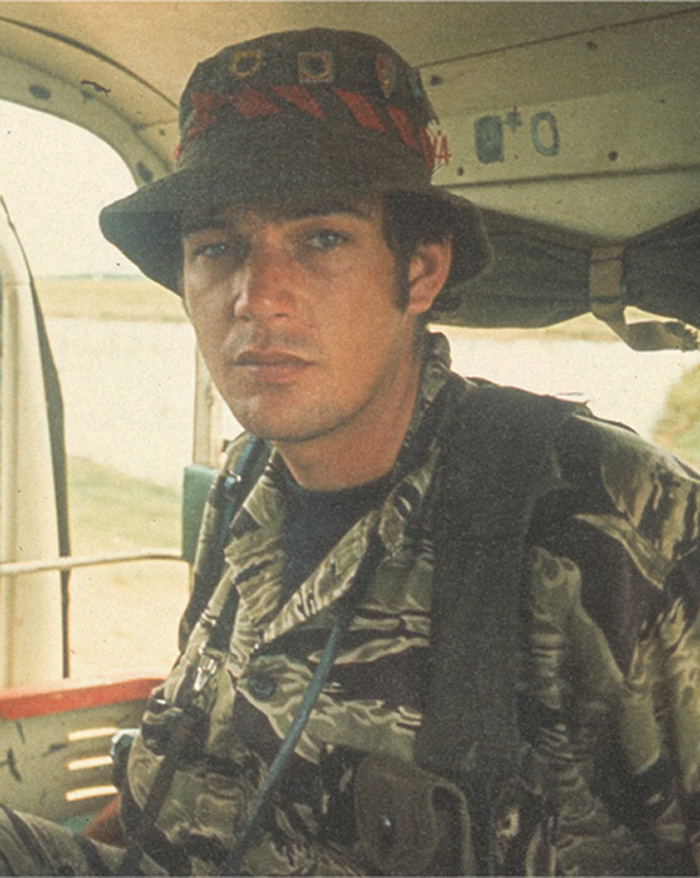
Please refer to the photo taken at a hovercraft base, Dong Tam, east of the Perfume river in Vietnam, 1968 at the back cover. The photo shows freelance photographer Tim Page wearing a striped camouflage shirt (Note). It was through the photo taken this legendary war photographer that I first learned about the Gold Tiger. Since then, I have touched with many original Tiger camo clothing, and I have been fascinated by their rich variety, the mysterious procurement and supply routes that inspire my imagination, and the unique faded colors. This is a story about Tigers.
Note) The color is green shade, the Camo Pattern is Gold, though.
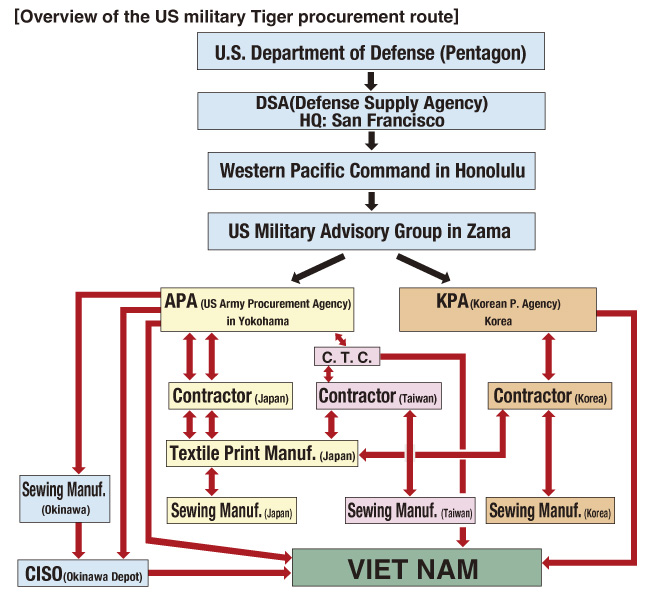
During the Vietnam War, the APA (US Army Procurement Agency), located in a corner of the Mitsubishi Corporation Building at 4-chome Honmachi, Naka-ku, Yokohama, Kanagawa Prefecture, was the procurement point for the US military in Japan during what was then known as the "Vietnam Special Demand.”
Normally, the Defense Supply Agency (DSA), headquartered in San Francisco, handled all procurement for the U.S. military, both domestic and international, and generally invited U.S. contractors to submit bids. However, there were exceptions, and only when the necessary quantity could not be procured domestically in the U.S. at the appropriate time would overseas procurement be considered. In fact, the U.S. military's troop strength in Vietnam, from 12,000 in August 1963 to 23,000 in October 1964 and 54,000 in June 1965, was rapidly expanding. Given the need to wage the Vietnam War, the DSA decided to procure many supplies from the Far East, taking advantage of geographical and cost advantages. During the Vietnam War, the U.S. Army Procurement Agency (APA), located in a corner of the Mitsubishi Corporation Building at 4 Honmachi, Naka-ku, Yokohama, Kanagawa Prefecture, was the procurement office for the U.S. military in Japan during what was then known as the "Vietnam Special Demand."
DSA decisions regarding overseas procurement of strategic materials necessary for the Vietnam War were passed through the Western Pacific Command in Honolulu, responsible for the Far East, and then sent to the U.S. Military Advisory Group in Zama. Under this direction, the APA handled procurement in Japan. Similarly, in Korea, the Korean Procurement Agency (KPA) handled procurement, and Taiwanese contractors were permitted to bid on APA through the Central Trust Corporation (CTC). Thus, in many cases, a three-way bidding war ensued between Japanese, Korean, and Taiwanese contractors for the Far East procurement of U.S. military strategic materials.
In fact, the procurement lists delivered to the US military through the APA throughout the Vietnam War covered almost every item necessary to carry out the war, and almost all of Japan's major trading companies and manufacturers were involved in the manufacturing and delivery of these items, and if you include the small factories that subcontracted them, you could say that the entire country of Japan was involved in the "Vietnam special demand.'' However, much of this procurement was a matter of military secrecy, and in Japan in particular, with social criticism of Japan's involvement in the Vietnam War growing daily, the masters and craftsmen of the small factories involved in the actual production often had no idea that the goods they were commissioning would be delivered to the US military.In fact, as I myself became interested in Vietnam Tigers and continued to make inquiries to various industry associations and Fabric print manufacturers, as well as interviewing former MACV-SOG members who were actually issued Gold Tigers at the time, I found that the barrier of 25 years (survey period 1991-2001), the secrecy of military procurement that is difficult for a civilian to access, and the lack of awareness at each manufacturing site, such as print factories and sewing factories, regarding US military orders because the orders were indirect, kept my research stuck in the dark for a long time.
In any case, among the huge list of supplies procured through the APA, there was a camouflage fatigues marked "jungle print," and this is the "Vietnam Tiger Camo" whose procurement and supply route we must trace.
It was unable to find any clear documents how many Tiger Camo fatigues were procured through APA from the early 1960s, when APA is believed to have begun procuring supplies for Vietnam, until the end of the war (withdrawal in 1975). However, Judging from a variety of sources, it appears that there were several procurements of 10,000 to 20,000 units, but the US military generally procured small lots of 1,000 to 5,000 units as needed.
And of course, not all Tiger procurements in the Far East were ordered and delivered to APA by Japanese contractors, and as mentioned above, fierce competitive bidding always took place, involving contractors from South Korea and Taiwan.
In addition, there seemed to be several cases where only the printed fabric was procured in Japan by APA, shipped to Okinawa, and completed at a sewing factory there. The reason for this is that until the signing of the Treaty of Reversion in 1971, Okinawa was a strictly dollar-based economic zone, and commissioning Okinawa sewing manufacturers was in line with the U.S. dollar defense policy at the time. This is likely the general flow of the type of product now known as the "Okinawa Tiger". However, with regard to the "Okinawa Tiger", investigations to date have found no evidence that the cotton fabric used was woven or printed in Okinawa, and it was believed that only sewing was carried out.
The same situation sometimes occurred when Korean or Taiwanese companies received orders. In these cases, Japanese trading companies would contract with Korean or Taiwanese companies to manufacture and export Tiger Camo print fabric.
In short, this meant that Japanese printing technology for fabric was at an unparalleled level in the Far East at the time.
Of course, not all Tigers were printed in Japan at the time, and Korea and Taiwan, which were successful in receiving orders, also produced printing of a certain level. Furthermore, among the variations known to the world as Vietnam Tigers, in addition to those procured by the U.S. military in Japan, which is what we are mainly considering here, there are also cases where they were exported to Vietnam from Japan, Korea, Taiwan, and other Southeast Asian countries as souvenir items and sold around bases, and cases where soldiers personally purchased them and actually used them in operations, as reported by soldiers themselves.
Needless to say, all of these variations fall under the category of Vietnam Tiger, but this report will be limited to Tigers procured with US military/government funding, specifically those procured in Japan through APA. The main reason for this is that, at least up until around 1968, most Tigers procured by the US military were procured in Japan through APA, either as finished products or as printed fabrics, and this likely included most major patterns.